Jarred Tuna vs Canned Tuna

Quality, food safety, packaging and buying decisions

Is tuna packed in a glass jar better than tuna packed in a metal can? Not necessarily. Both formats can preserve high-quality tuna when correctly processed. The most useful comparison considers the fish, ingredients, thermal processing, packaging performance and intended market.

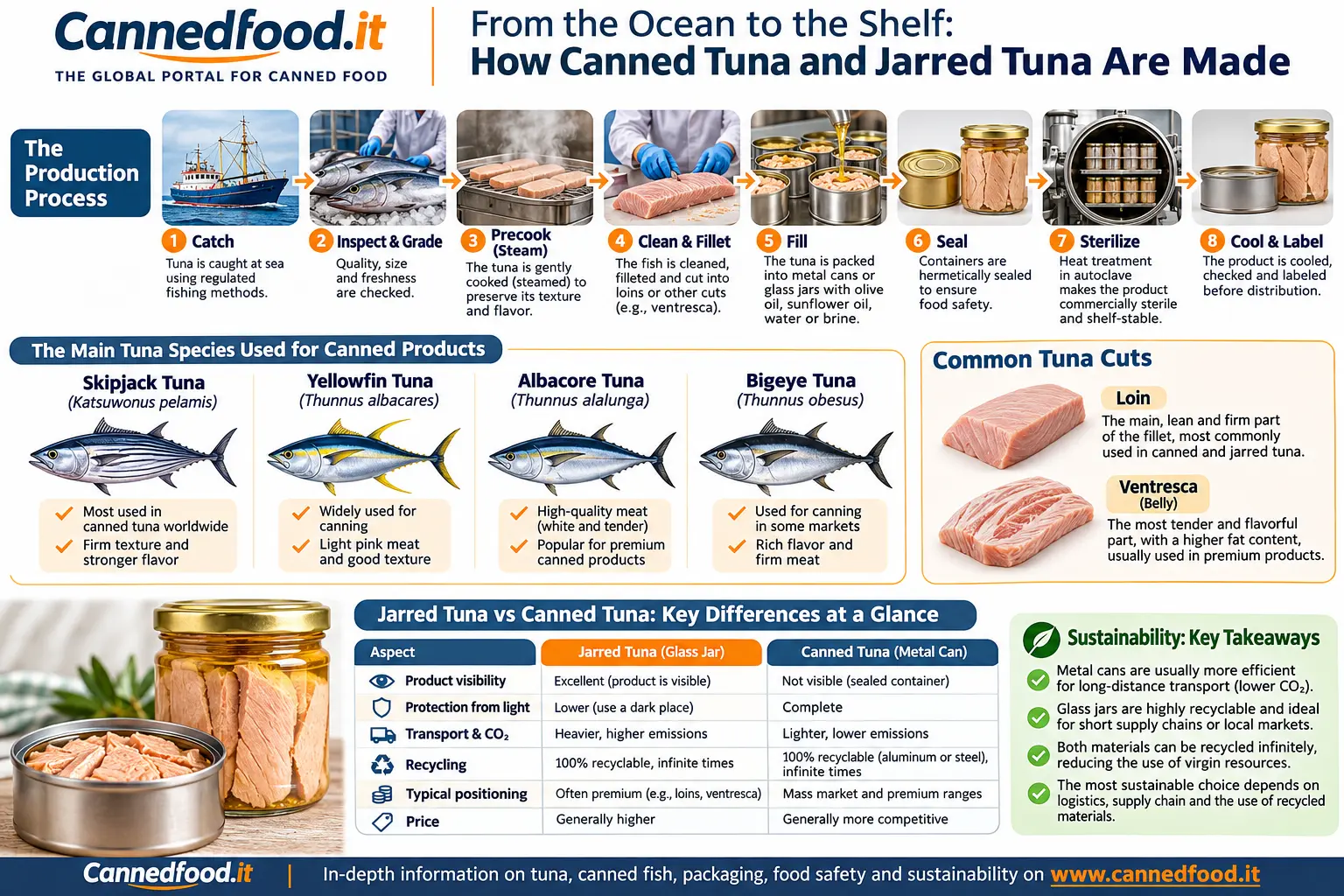
Cannedfood.it infographic comparing jarred and canned tuna: production stages, tuna species, packaging and sustainability
Cannedfood.it infographic: tuna processing, packaging differences and sustainability. View full size.
Key takeaway: A glass jar allows shoppers to see the fillets; a metal can protects the product from light. Neither packaging format alone proves better taste, nutrition, safety or sustainability.

Jarred tuna vs canned tuna: side-by-side comparison

CriterionGlass jarMetal can
Product visibilityContents visible before purchaseContents hidden until opening
Light protectionLimited unless protected by label or outer packagingOpaque barrier
Impact resistanceBreakableGenerally more impact-resistant, but may dent
Shipping weightOften heavier for comparable contentsOften lighter
Reclosure after openingUsually possible with the original lid; refrigerate promptlyTypically requires transfer to a covered food-safe container
Shelf lifeDepends on validated processing, seals, formulation and storage conditions; not the material alone
RecyclingWidely recyclable where glass collection existsWidely recyclable where metal collection exists
Market positioningOften used for visible premium filletsUsed across value, mainstream and premium ranges

These are general packaging characteristics; actual performance depends on container design, closures, coatings and local recycling systems.

Does jarred tuna taste better?

Not automatically. Species, fish quality, cut size, cooking method, packing medium, salt level and storage conditions can affect flavour and texture. Glass jars are often chosen to display intact fillets, but premium tuna is also sold in metal cans.

Compare products with the same species, packing medium and drained weight before attributing a sensory difference to the container.

Nutrition and mercury

Both formats can provide protein and other nutrients. Nutritional differences are more closely linked to tuna species, recipe, oil or brine, salt content and serving size than to glass versus metal.

Mercury exposure depends principally on the species and fish, not whether the tuna is packed in a jar or can. Follow the seafood-consumption advice relevant to your country, especially for pregnancy and young children.

Food safety and preservation

Commercial shelf-stable tuna in either format requires a validated heat process, suitable hermetic closure and hygienic production. Tuna is a low-acid food, so correct commercial sterilisation is critical to control serious hazards, including Clostridium botulinum.

Inspect containers before use: avoid jars with broken seals or damaged glass and cans that are leaking, swollen or severely damaged. Follow the manufacturer's storage instructions. After opening, refrigerate promptly and consume within the labelled period.

Important: A transparent jar is not inherently safer than a metal can, and a metal can is not inherently less healthy. Safety depends on the complete food-contact packaging system and manufacturing controls.

Glass Jars vs Metal Cans: Which Is More Sustainable?

Neither glass nor metal is universally the more sustainable packaging choice. The environmental outcome depends on the complete life cycle: raw materials, manufacturing energy, packaging weight, transport, reuse, collection and recycling. Tuna cans may be made from steel (often tinplate) or aluminium, and these materials have different environmental profiles.

1. Transportation and CO₂ emissions

Glass jars: Glass packaging is often heavier than a comparable metal can and can break during distribution. Added transport mass and protective secondary packaging may increase logistical impacts, particularly on long routes. The actual emissions depend on vehicle loading, distance, transport mode and the packaging design.

Metal cans: Steel and aluminium cans are typically robust and can offer advantages in packing density, breakage resistance and transport weight. However, a lower packaging weight does not automatically establish a lower total product carbon footprint.

2. Recycling and the circular economy

Glass: Glass can be recycled repeatedly without inherent loss of its basic material properties, provided it is collected, sorted and processed appropriately. Remelting nevertheless consumes substantial energy, and recycling outcomes vary by local infrastructure and contamination levels.

Steel and aluminium: Both metals can also be recycled repeatedly. Recycling aluminium can use approximately 95% less energy than producing primary aluminium, depending on the processes compared. This is a material-production comparison, not a claim that an aluminium tuna can has a 95% lower overall environmental impact. Steel recycling also reduces demand for virgin raw materials, with savings varying by production route.

3. Raw materials and manufacturing impact

Glass: Glass is primarily manufactured from silica sand, soda ash and limestone, often with recycled cullet. Its production requires high-temperature melting and associated energy, while raw-material extraction and processing also have environmental impacts.

Metal: Primary aluminium production involves bauxite mining, alumina refining and electricity-intensive smelting; steel production involves iron ore or recycled scrap and energy-intensive processes. Environmental impacts can include land disturbance, greenhouse-gas emissions, water use and industrial residues. Increasing recycled content may reduce several of these impacts, but the result depends on the supply chain and energy mix.

4. Which packaging should buyers choose?

Practical conclusion: Metal cans can be advantageous for long-distance distribution where low weight, efficient palletisation and resistance to breakage matter. Glass jars may be attractive for premium presentation and can perform well in suitable local collection or verified reuse systems. Domestic reuse of an empty jar is useful, but does not by itself prove a lower overall environmental footprint.

For a reliable comparison, buyers should request product-specific life-cycle assessment (LCA) data using the same functional unit (for example, packaging required to deliver 1 kg of drained tuna), together with information on recycled content, actual packaging weight, transport and end-of-life assumptions.

Packaging sustainability is not fishing sustainability. Responsible tuna sourcing also depends on fish stock status, fishing methods, bycatch and traceability. Read our FAO Fishing Areas guide to understand what fishing-area codes do—and do not—tell buyers.
Price, market positioning and retail presentation

Glass jars are frequently used to display intact tuna fillets and communicate a premium positioning. Metal cans serve both value and premium ranges, from tuna flakes to carefully selected solid fillets. Neither packaging format establishes the grade of fish on its own.

Retail shelf prices should not be compared only per container: buyers should calculate the price per kilogram of drained tuna, taking into account the declared net weight, drained weight, oil or brine, species and cut.

Commercial factorGlass jarMetal can
Product visibilityContents visible before purchaseRequires photography or descriptive labelling
Typical positioningOften premium or specialityEconomy, mainstream and premium
Transport and breakageHigher tare weight; breakage protection neededUsually lighter and more impact-resistant
Private-label decisionsAppearance, closure and light exposureCan size, easy-open end and internal coating

For procurement, request comparable quotations based on drained weight, minimum order quantity, pallet configuration, shelf life, packaging specification and destination-market compliance.

Checklist for importers, retailers and private-label buyers

  1. Confirm species, scientific name, cut type and country of processing.
  2. Compare net weight and drained weight, not retail price per pack alone.
  3. Specify oil, brine or other packing medium, salt and ingredient declaration.
  4. Request container specifications, closure integrity and shelf-life validation.
  5. Evaluate case packing, pallet efficiency, breakage or dent risk and shipping costs.
  6. Check food-contact compliance and labelling for the destination market.
  7. Request traceability, catch information and evidence for sustainability claims.

For B2B tenders, the right choice depends on target shelf price, desired presentation, logistics and documented supplier performance.

Frequently asked questions

Is tuna in a glass jar healthier?

No general conclusion follows from the packaging alone. Compare species, ingredients and nutrition labels.

Does jarred tuna last longer?

Not necessarily. Unopened shelf life depends on the validated product and packaging system; follow the best-before date and storage instructions.

Is canned tuna lower quality?

No. Metal cans are used for both everyday and premium tuna products.

Which format is better for shipping?

Metal cans often offer advantages in weight and breakage resistance, but total costs depend on the specific pack and distribution route.

Which should you choose?

Choose jarred tuna when visual presentation and visible fillets are a priority. Choose canned tuna when light protection, efficient distribution and a broad range of pack sizes matter most. For either format, prioritise product specifications, food safety, traceability and value for money.

References and further reading

Editorial information only. Product specifications, shelf-life claims and regulatory requirements must be checked for the relevant market and manufacturer.

😥 Any bug here? ❗ Any mistake in this page?
Please inform us by email or WhatsApp. Thank you.